
The Complete Prop Firm Challenge Preparation Guide

Table of Contents
Challenge preparation is an operating project, not a confidence exercise. Before the clock starts, turn the firm's published terms into numbers, test the orders you will use, and decide exactly what would make you stop for the day.
Start by designing for survival rather than the target. A trader who knows the remaining loss allowance, the next scheduled market event, and the maximum permitted exposure has more useful information than one watching a percentage-to-target meter.
If you are comparing independent preparation with structured support, the main prop firm passing service guide places the complete prop firm challenge preparation guide inside the complete evaluation process.
Select the Program
Compare programs with your actual holding period, instruments, and available trading hours. A short intraday trader should not choose a program whose reset time or news restriction repeatedly blocks the only session they trade.
Put each candidate in a one-page comparison. Include fee, target, daily and total loss method, minimum days, time limit, commissions, platform, payout terms, and every restriction that touches your setup.
- Download the current terms and date the copy.
- Check whether drawdown is balance- or equity-based.
- Confirm permitted instruments and overnight holding.
- Calculate the fee and reset cost you can afford to lose.
Translate the Rules
Do not leave a rule as a sentence in a browser tab. Rewrite “5% daily loss” as the exact dollar level, reset time, whether floating loss counts, and the buffer at which you personally stop.
Ask support in writing about any ambiguous point, especially copied trades, expert advisors, news windows, and multiple accounts. Save the answer with the version of the rules; forum recollections can be outdated.
- Record the breach threshold and a lower personal stop.
- Note server time beside your local time.
- List restricted events and holding windows.
- Write the permitted order and automation methods.
Validate the Strategy
Review a meaningful set of historical and simulated trades using the same session, instrument, stop logic, and spread assumptions planned for the evaluation. Separate results by market condition so one strong week does not disguise a weak process.
Validation also means defining absence. If an entry needs a liquid London open and a retest, state that no trade is allowed when price has already moved or a high-impact event is close.
- Log win rate, average win, average loss, and costs.
- Test entries at realistic spread and slippage.
- Define invalidation before placing an order.
- List conditions that prohibit a trade.
Related guide for The Complete Prop Firm Challenge Preparation Guide: A useful companion for this decision is How to Check Prop Firm Rules Before You Start a Challenge. Many failed evaluations begin with a rule the trader did not know existed. Save this checklist and review the firm's own terms before you place the first trade.
Calculate the Risk Plan
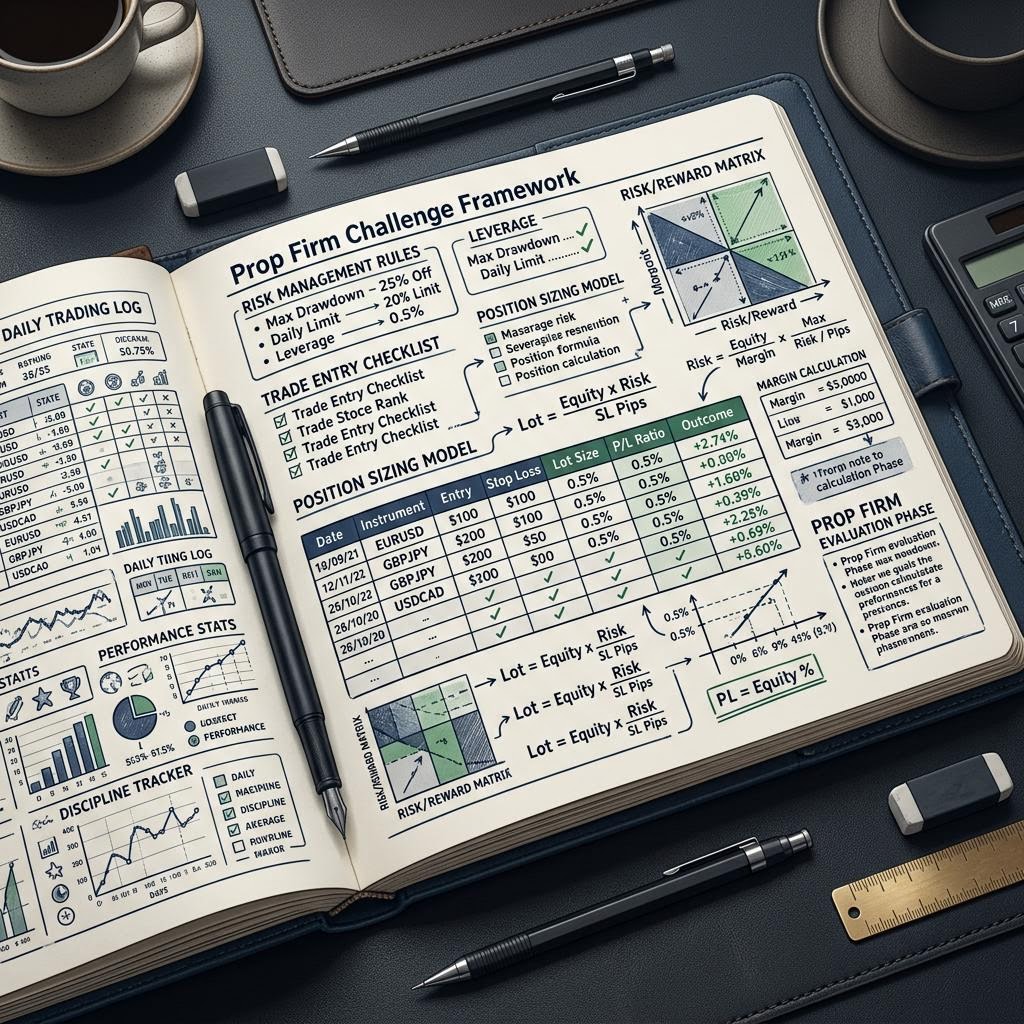
Risk is a chain of limits: loss per trade, combined loss across correlated positions, daily stop, and total-account buffer. On a $100,000 account, 0.25% risk is $250, but two highly correlated positions can behave like one $500 bet.
Size from the distance to the stop and the contract value, not from a familiar lot size. Recalculate after each loss because the usable buffer, not the original account balance, determines the next decision.
- Set a fixed maximum loss per idea.
- Cap combined exposure in correlated markets.
- Use a personal daily stop below the firm's limit.
- Pre-calculate size for each instrument.
Prepare the Technology
Log into the exact challenge server before day one and verify account number, leverage, symbol suffixes, lot limits, and margin behavior. A symbol that looks like EURUSD may have a different contract specification from the chart used in testing.
Test an alert, a pending order, a market order, modification, partial close, and stop-loss placement with permitted practice access. Keep an alternate internet connection and the broker or firm support route available.
- Confirm server, credentials, and account type.
- Check symbol specifications and tick value.
- Test alerts on desktop and phone.
- Write an outage and emergency-close procedure.
Rehearse the Routine
Run at least several sessions as if the account were live. Open the calendar, mark your trading window, calculate available risk, wait for only planned setups, and complete the journal even if no order is placed.
A rehearsal should expose friction: an alert that arrives late, a position-size calculator with wrong units, or a tendency to trade after the session. Fix the workflow rather than promising to remember better.
- Use the same charts and templates each rehearsal.
- Time the pre-market preparation.
- Record skipped trades and why.
- Review one complete session before changing rules.
Related guide for The Complete Prop Firm Challenge Preparation Guide: For the next practical part of your preparation, continue with What a Professional Prop Firm Passing Plan Should Look Like. A professional plan is visible, measured, and rule-aware. Learn what should be included before a provider asks you to trust the process.
Onboard a Passing Service Carefully
First confirm that the firm's terms allow the proposed support model. Coaching, trade review, signals, and third-party execution have different permissions and risks; the service name alone does not answer the compliance question.
A responsible provider can explain scope, access, communications, risk ceiling, records, and how you revoke access. Do not share credentials with a provider that promises a result, obscures methods, or suggests hiding activity.
- Obtain the firm's position on third-party involvement.
- Agree written risk and pause limits.
- Use least-privilege access where possible.
- Keep your own account and activity records.
The Go-Live Checklist
Start only when the rule sheet, risk table, and technology checks agree with the account dashboard. If a material answer is still unclear, delaying a paid attempt is usually cheaper than discovering the interpretation through a breach.
The final decision is also personal. Skip the opening session if you are sick, rushed, unable to monitor positions, or tempted to recover an unrelated loss. The account begins with the first trade, not with the fee.
- Reconfirm available daily and total loss buffer.
- Check calendar, session, and personal availability.
- Verify platform connection and emergency contact.
- Sign off on the first-day maximum risk.
Final Takeaway
Preparation cannot create a winning trade, but it can remove common preventable failures: wrong sizing, misunderstood resets, unsupported automation, and trading when a setup is absent.
Keep the preparation pack during the evaluation. Update only factual fields such as remaining buffer and rule notices; do not redesign the system after every outcome. For the wider comparison, return to the prop firm challenge passing service guide before choosing an evaluation or support provider.